Geochemistry
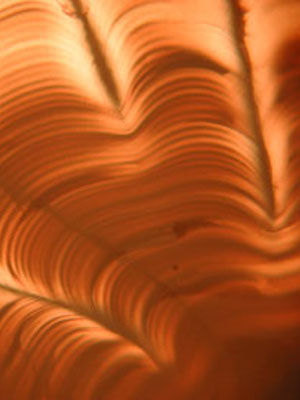
Elemental & Isotopic Analysis
The Quadrupole ICP-MS Laboratory (with laser ablation) is principally used for rapid, precise and accurate trace element (<1000 ppm) determinations in liquid and solid samples, but other applications include isotopic determinations and speciation studies.
The power of modern ICP-MS resides in its ability to rapidly measure trace elements at very low detection limits (to sub parts per trillion levels) as well as minor and major elements (at parts per million levels) in the same analytical run on suitably diluted samples.
- Contact Nathan Miller and Marek Locmelis for details.
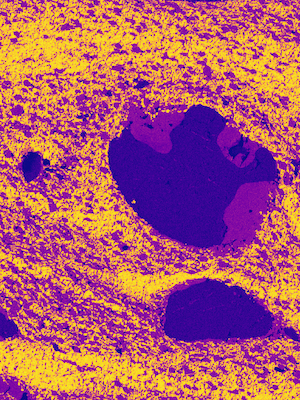
E-beam Lab
The E-beam Lab houses an electron microprobe with five wavelength-dispersive spectrometers (WDS) and a large-area energy-dispersive spectrometer (EDS) on our low-vacuum SEM for non-destructive in-situ elemental characterization. Both can be used to qualitatively or quantitatively map elemental concentration variations (>100s of ppm) from the micron to the cm scale, as well as ~1 cubic micron focused beam analyses (>10 ppm).
Instruments are optimized to collect data from different types of samples and a broad diversity of research occurs in the lab.
- Contact Kenneth Befus for details.
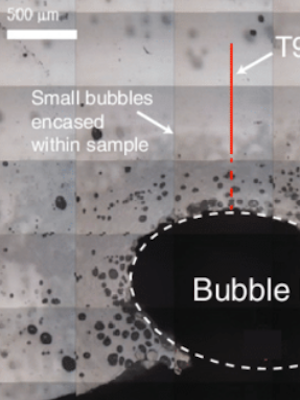
Fourier Transform Infrared Spectroscopy
Infrared spectroscopy uses Fourier-Transform Infrared (FTIR) analyses to measure dissolved water and carbon in natural and experimental silicate glasses.
The FTIR lab is equipped with a Thermo Electron Nicolet 6700 FTIR spectrometer and Continuum IR microscope, equipped with automated x-y-z stage and stage purge system so that the spectrometer, microscope, and sample position are all purged with dry air that has <10 ppm CO2 for very precise measurements of CO2 poor glasses. Dedicated polishing facilities are also available for sample preparation.
- Contact Jim Gardner for details.
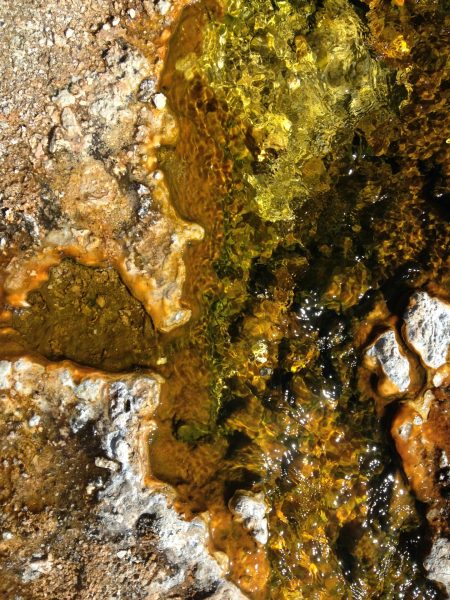
Aqueous Geochemistry & Geomicrobiology
The Aqueous Geochemistry and Geomicrobiology Laboratory focuses on characterizing the chemistry of waters, and the properties and reactivity of solids including minerals, engineered solids, pyrogenic carbon, and microbes.
The laboratory houses instruments including an inductively coupled plasma-mass spectrometer (triple quadrupole), an automated potentiometric titrator, a spectrophotometer, and equipment for the culturing, growth and handling of soil and water microorganisms.
- Contact Dan Alessi for details.