Geophysics
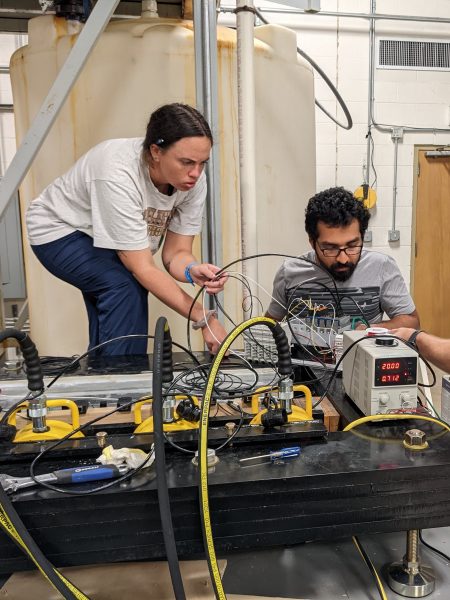
Geomechanics and Geofluids
UT GeoMechanics and GeoFluids is a state-of-the-art rock and sediment mechanics lab focused on the rheology, deformation and hydrogeology of Earth materials.
The lab addresses fundamental research questions that underpin geohazards, Earth resources, and the carbon cycle, through learning about our planet’s crust and the processes that shape its surface and climate.
The lab includes facilities for pressure core experimentation and geotechnical analysis.
- Contact Peter Flemings and Demian Saffer for details.
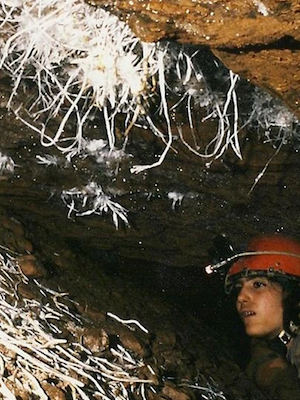
Mineral & Rock Physics
The Rock Deformation Lab has a number of capabilities including Bevo-Q that measures the attenuation of seismic waves in liquids, a WIGED apparatus, an NER AutoLab 1500, an ultrasonic facility, a pycnometer, a low-pressure permeameter, and other capabilities.
- Contact Nicola Tisato for details.
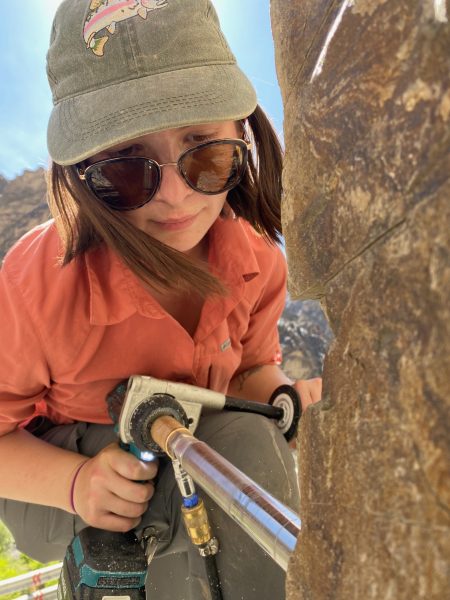
Paleomagnetism
The UT MagLab is a facility for high precision paleomagnetic and rock magnetic measurements. The lab addresses fundamental questions in plate tectonics, paleogeography, the history of Earth’s geodynamo, and archeology, by studying the magnetic records preserved in rocks and sediments.
The lab operates a liquid-helium-cooled 2G Enterprises Superconducting Rock Magnetometer (SRM) with a RAPID Consortium sample handling system contained inside a mu-metal magnetically shielded room. The SRM is equipped with an in-line alternating field demagnetization system and magnetically shielded ASC Scientific thermal demagnetizer ovens.
- Contact Craig Martin for details.
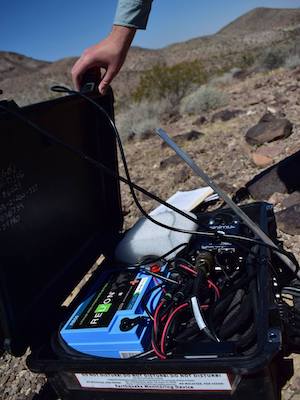
Portable Field Equipment
Geophysical equipment–often portable field equipment–includes a number of items: gravimeters (including a GWR superconducting gravimeter), seismometers, magnetometers, and a vibroseis seismic source. The latter is managed through the NSF facility in Civil Engineering, creates low and high frequency 3-axis shaking.
- Contact Kyle Spikes for details.